Childbirth Delay and Astrology: Understanding the 5th House
Having questions about childbirth or family expansion can bring uncertainty. In Vedic astrology, the 5th house is traditionally linked with children, creativity and progeny. Astrologers study this house, its ruling planet and other planetary positions to understand Santan Yog.
Child problems astrology focuses on traditional interpretations of the 5th house, Jupiter, the 9th house and planetary periods. These factors may offer a spiritual perspective on family-related questions. However, astrology cannot diagnose fertility issues or predict medical outcomes.
What Is the 5th House in Vedic Astrology?
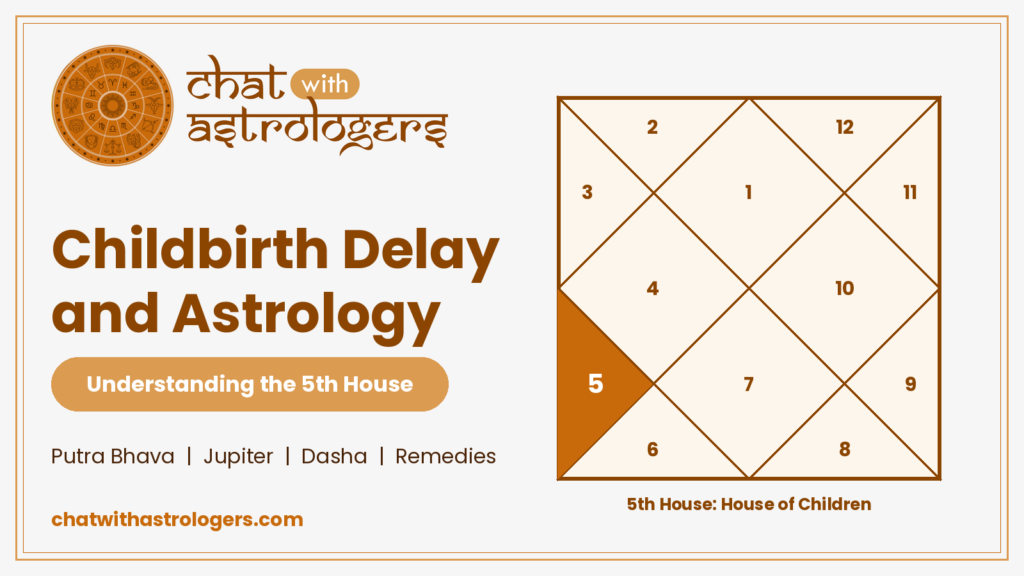
The 5th house is known as Putra Bhava in Vedic astrology. It represents children, education, intelligence, creativity and past-life merit. It is one of the important houses examined during progeny-related chart analysis.
An astrologer usually checks three important factors:
5th House: Its zodiac sign, planetary placements and aspects.
5th Lord: The planet ruling the 5th house and its position in the birth chart.
Jupiter (Guru): Traditionally considered the natural significator of children, growth and wisdom.
These factors are studied together rather than separately. A complete Kundli reading also considers the Ascendant, Moon sign and planetary periods.
How Does Astrology Interpret Childbirth Delays?
In traditional astrology, certain planetary combinations are associated with delays in childbirth. However, these combinations should never be treated as definite predictions.
Astrologers examine the overall birth chart before forming an interpretation. They may also study the running Mahadasha, Antardasha and current planetary transits.
1. Saturn’s Influence on the 5th House
Saturn represents patience, discipline, responsibility and time. Its influence on the 5th house or its ruling planet is sometimes associated with delays.
Astrologers also examine Saturn’s strength, sign placement and planetary aspects. Saturn’s presence alone does not establish a negative outcome.
2. Jupiter and Santan Yog
Jupiter is traditionally associated with children, knowledge and expansion. Its placement and strength are important during progeny-related Kundli analysis.
A well-supported Jupiter may be interpreted as a favourable influence. An astrologer also checks Jupiter’s relationship with the 5th house and its ruling planet.
3. Rahu and Ketu in the 5th House
Rahu and Ketu are shadow planets in Vedic astrology. Their placement in the 5th house may receive special attention during chart interpretation.
Some traditions associate these placements with uncertainty or unusual circumstances. Their influence depends on the complete chart and supporting planetary combinations.
4. Weak or Afflicted 5th Lord
The 5th lord represents the house of progeny and its associated themes. Astrologers examine its sign, house placement, conjunctions and aspects.
A challenging placement may be interpreted as an area requiring attention. However, one planetary position cannot determine whether someone will have children.
What Is Santan Yog in Astrology?
Santan Yog refers to planetary combinations traditionally associated with children and progeny in Vedic astrology.
Astrologers study the relationship between the 5th house, its ruling planet and Jupiter. They may also examine the 9th house, which represents fortune, blessings and spiritual merit.
A complete analysis may include:
Strength and placement of the 5th lord.
Jupiter’s position and planetary aspects.
The condition of the 9th house.
Relevant Mahadasha and Antardasha periods.
The Saptamsha chart, also known as D7.
The D7 chart is a divisional chart traditionally used for studying children and progeny. It provides additional context alongside the main birth chart.
No single combination guarantees childbirth or establishes a person’s fertility.
Role of Dasha and Planetary Transits
Dasha systems help astrologers understand the timing of different life themes. Mahadasha represents a major planetary period, while Antardasha represents its sub-period.
During progeny-related analysis, astrologers may examine periods connected with Jupiter, the 5th lord and the 9th lord.
Planetary transits are also considered. Jupiter and Saturn receive particular attention because of their traditional astrological significance.
These interpretations represent belief-based timing methods. They should not be used to predict conception, pregnancy or childbirth.
Traditional Putra Dosh Remedies
In Vedic astrology, Putra Dosh refers to certain planetary combinations traditionally associated with challenges concerning progeny.
Some families follow spiritual practices for peace, devotion and personal comfort. The appropriate practices vary according to individual beliefs and traditions.
1. Worship Lord Vishnu
Some devotees worship Lord Vishnu and offer prayers for family well-being. Regular prayer can become a meaningful part of their spiritual routine.
2. Chant Traditional Mantras
Some traditions recommend chanting the Santan Gopal Mantra with devotion. Families may follow their own prayer routines under guidance from a knowledgeable priest.
3. Practise Charity and Service
Charity is an important practice in many Hindu traditions. Donating food, supporting children in need and helping families can be meaningful acts of service.
4. Worship Lord Shiva and Goddess Parvati
Some devotees worship Lord Shiva and Goddess Parvati together. Their prayers are traditionally associated with family harmony, love and blessings.
These practices are optional spiritual traditions. No mantra, ritual or remedy is scientifically proven to improve fertility or guarantee childbirth.
Practical Guidance Alongside Astrology
Family planning involves personal, emotional and medical considerations. Astrology may provide a traditional spiritual perspective, but practical support remains important.
Consider these steps:
Discuss family planning openly with your partner.
Consult a qualified medical professional about fertility concerns.
Avoid unnecessary stress caused by astrological predictions.
Do not delay medical advice while following spiritual remedies.
Choose spiritual practices that respect your beliefs and budget.
Remember that every person’s circumstances are different. There is no reason to blame yourself or your partner for reproductive challenges.
How to Consult an Astrologer for Child-Related Questions
If you want to understand Santan Yog in your birth chart, consider a personalised astrology consultation.
Prepare your date of birth, exact birth time and birthplace. These details help an astrologer prepare and examine your Kundli.
You can explore online astrology consultations through Chat With Astrologers. Choose an available astrologer and discuss your questions through the consultation options offered on the platform.
Ask the astrologer to explain the 5th house, 5th lord, Jupiter, D7 chart and relevant planetary periods. A responsible consultation should explain traditional interpretations without creating fear or promising specific outcomes.
Frequently Asked Questions (FAQs)
1. Which house represents children in Vedic astrology?
The 5th house, also known as Putra Bhava, traditionally represents children and progeny. Astrologers examine its ruling planet, Jupiter and relevant planetary aspects. They may also study the 9th house and D7 chart. These factors provide a traditional astrological perspective, not a medical assessment.
2. What is Santan Yog in a birth chart?
Santan Yog refers to planetary combinations traditionally associated with children and progeny. Astrologers examine the 5th house, its ruling planet, Jupiter and the D7 chart. The overall birth chart matters more than one placement. Such combinations cannot guarantee childbirth or predict fertility outcomes.
3. Can Saturn cause delays in childbirth according to astrology?
Some Vedic astrology traditions associate Saturn’s influence on the 5th house or its ruling planet with delays. However, Saturn alone cannot determine childbirth outcomes. Astrologers consider other planetary placements, dashas and divisional charts before offering a traditional interpretation.
4. What are traditional Putra Dosh remedies?
Traditional practices may include worshipping Lord Vishnu, chanting the Santan Gopal Mantra, praying to Lord Shiva and Goddess Parvati, and practising charity. These activities may offer spiritual comfort to devotees. They are not medically proven fertility treatments and cannot guarantee childbirth.
Conclusion and CTA
Understanding the 5th house can help beginners learn how Vedic astrology approaches children and progeny. Jupiter, the 5th lord, Santan Yog, D7 chart and planetary periods are important parts of this traditional interpretation.
However, childbirth is a personal journey, and astrology cannot establish medical causes or guarantee outcomes. Combine spiritual practices with appropriate professional guidance and supportive family discussions.
For personalised guidance about your birth chart, visit Chat With Astrologers and connect with an astrologer through the available consultation options